Choosing a golf ball is easy until you start reading the box.
Soft feel. Low compression. High launch. More distance. Tour-level spin. Before long, it can seem as if finding the right ball requires knowing your driver swing speed to the decimal point.
For senior golfers, the advice can be even more confusing. There is a common assumption that getting older automatically means switching to the softest, lowest-compression ball available. That may work well for some players, but it is not a rule.
The best golf balls for seniors are the ones that fit the way you play today. Your ball should give you the flight you want, dependable distance, useful control on approach shots, and a feel you like with your wedges and putter. Age alone does not tell you which ball can do that.
Here is what really matters when choosing one.
What is the best golf ball for seniors?
There is no single best golf ball for every senior golfer. A good choice should complement your ball flight, provide the distance and control your game needs, and feel comfortable from the tee all the way to the putting green.
That last part is worth emphasizing. The driver gets most of the attention when golfers shop for a ball, but you may only hit it 10 to 14 times during a round. You use your golf ball on every shot.
That is why choosing a ball strictly according to driver swing speed can be misleading. Titleist, for example, advises golfers to look at the ball's overall performance rather than fitting exclusively by driver speed. Every golfer produces a range of swing speeds during a round, from a full driver to a half wedge or a short chip.
For a senior golfer, a better starting question is not "What ball should someone my age play?" It is "What would I like my golf ball to do better?"
The answer might be more carry, a different trajectory, better stopping power into greens, a softer feel, or simply more predictable performance throughout the bag.
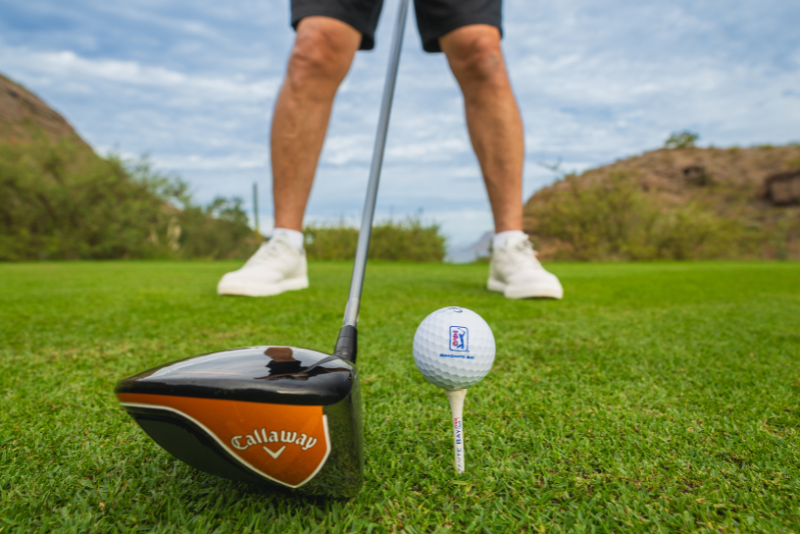
What should senior golfers look for in a golf ball?
Golf balls can look nearly identical in your hand and perform quite differently once you put them in play. When comparing options, pay particular attention to flight, spin, feel, distance and how the ball responds on scoring shots.
Compression
Compression is one of the terms senior golfers encounter most often. In simple terms, it is a measurement related to how firm or soft a golf ball is.
Where golfers get into trouble is assuming that compression tells the entire story.
It does not.
A golf ball's performance comes from its complete construction, including the core, additional layers, cover and dimple pattern. Titleist notes that compression is only one design element and that knowing a ball's compression number alone does not tell you how that ball will perform.
So, while a lower-compression ball may provide the softer sensation some golfers prefer, "lower compression" should not automatically be read as "better for seniors."
Ball flight
Pay attention to what happens after impact, not just how the ball feels when you strike it.
If your normal trajectory has become lower over the years, a ball that helps produce a flight you are comfortable with may be worth testing. On the other hand, a player who already launches the ball high may have completely different needs.
The important thing is to evaluate your actual flight with your own clubs. Watch the height, carry and how the ball behaves when it lands.
Distance
Nobody complains about gaining a few yards, but chasing distance alone is rarely the best way to choose a golf ball.
Imagine Ball A gives you a little more distance with the driver but makes it harder to control approach shots. Ball B is a few yards shorter from the tee but gives you a trajectory you trust and better stopping power with your irons.
Which one is really longer where it counts?
That answer depends on your game and the course in front of you.
Distance matters, particularly if carrying hazards or reaching greens in regulation has become more difficult, but it should be evaluated alongside the rest of the ball's performance.
Spin and control
This is where many golfers should spend more time testing.
A golf ball needs to perform on full shots, but it also needs to handle the scoring end of the game. Hit pitches from 40 or 50 yards. Try chips from different lies. Hit several mid-irons into a green and watch what happens after the first bounce.
Does the ball release farther than you expect? Does it stop quickly enough? Can you predict what it is going to do?
Those observations are often more useful than simply comparing two drives.
Feel
Feel is personal, and there is nothing wrong with that.
Some golfers like the muted sensation of a softer ball off the putter face. Others prefer a firmer response. The same applies to wedges and irons.
If two golf balls give you similar performance but you strongly prefer the feel of one, that is a perfectly legitimate reason to choose it. Confidence matters in golf, especially when you are standing over a six-foot putt.

Are soft golf balls better for seniors?
Soft golf balls can be a good option for senior golfers who prefer their feel, but they are not automatically better simply because a golfer is older or has lost some clubhead speed.
This is one of the more persistent equipment myths.
Lower compression is often associated with slower swing speeds, but compression by itself does not determine distance. Golf ball manufacturers combine numerous design elements to produce a particular flight, spin profile and feel. Titleist specifically cautions against assuming that a lower-swing-speed player will necessarily hit a lower-compression ball farther.
That does not mean you should avoid soft golf balls. Far from it. If you like the feel and the ball gives you the performance you want, play it.
Just do not choose it because the word "senior" appears on your scorecard.
What golf ball compression is best for seniors?
There is no universal compression number that every senior golfer should use.
Two players in their 60s or 70s can have entirely different swings. One may still generate plenty of speed and prefer a firmer-feeling ball. Another may have a smoother tempo and prefer something noticeably softer. A third may care far more about greenside performance than either of those characteristics.
Compression can affect speed, spin and trajectory, but it works together with the rest of the ball's design.
Rather than shopping for a specific compression number, start with the performance you want and test from there.
| If you are looking for... |
Pay attention to... |
Ideal Ball Category |
| More distance & carry |
Carry, launch, and low long-game spin |
Low-Compression 2-Piece Distance Balls (durable ionomer cover, large energy core) |
| A softer feel around greens |
Wedge response, putter feel, and stopping power |
Mid-Compression Soft Hybrid Balls (soft ionomer/hybrid cover, low-to-mid compression) |
| Better approach-shot control |
Trajectory, greenside spin, and stopping behavior |
Multilayer Urethane Tour-Style Balls (thin urethane cover, multi-piece construction) |
The key word is performance. The number printed in a product description matters less than what happens when you put the ball in play.
How does swing speed affect golf ball choice?
Swing speed is useful information, but it should not make the decision by itself.
One reason is simple: you do not have one swing speed.
Your driver, 7-iron, pitching wedge and 30-yard pitch are all delivered at different speeds. A golf ball has to perform during every one of those shots.
That is why evaluating a ball only by what happens with the driver gives you an incomplete picture. Titleist's fitting philosophy, for example, evaluates the golf ball as part of the golfer's overall equipment setup and considers launch conditions such as spin, trajectory and landing characteristics.
If your driver speed has decreased over time, it is certainly reasonable to retest your golf ball. Your ideal launch or flight characteristics may have changed along with it.
But think of swing speed as one piece of information, not a prescription.

How to choose the best golf ball for your game
The best testing does not have to be complicated. In fact, you can learn quite a bit by taking two or three golf balls onto the
course and paying attention.
1. Start around the green
This may sound backward, but it is one of the best places to begin.
Hit short chips, longer chips, pitches and bunker shots. Pay attention to how quickly each ball comes off the clubface and what it does after landing.
Then putt with each one.
You will probably eliminate at least one option fairly quickly based on feel or control.
2. Move back to your wedges and short irons
Hit shots from distances you encounter regularly.
You are looking for predictable flight and predictable stopping power. A ball that flies the right distance but repeatedly releases farther than you expect may not be the best fit for your game.
3. Test your mid and long irons
Now look at trajectory, carry and landing behavior.
This is particularly important for golfers who have lost some speed. Holding a green with a mid or long iron can become more challenging if the ball arrives too low or without enough stopping power.
Category to test: If you struggle to hold greens with long irons, test a Multilayer Urethane Ball. The soft cover grabs club face grooves on approach shots to give you the trajectory and spin required to stop the ball quickly.
4. Finish with the driver
Now you can compare distance, flight and consistency from the tee.
Yes, distance matters. But by this point you also know how each ball performs on the other shots that make up most of your round.
That gives you a much better basis for making a decision.
Category to test: If tee-shot distance is your primary concern, focus on Low-Compression 2-Piece Balls. These are engineered to lower driver spin off the face, maximizing roll and carry for moderate swing speeds.
5. Play the same ball consistently
Once you find a ball you trust, give it a proper chance.
Constantly switching between models makes it harder to learn how far your shots carry and how the ball will react around the green. Playing one model consistently removes a variable from a game that already has plenty of them.

Should senior golfers use a different golf ball as they get older?
Not simply because another birthday has passed.
You should consider changing golf balls when your game changes.
Maybe your driver carry has dropped noticeably. Perhaps your iron trajectory is lower than it used to be. Maybe you have changed clubs, adjusted your swing, or simply want a softer feel around the greens.
Those are good reasons to test something different.
Age, by itself, is not.
Golfers sometimes keep playing the same equipment for years because it is familiar. There is value in familiarity, but there is also value in occasionally checking whether your equipment still suits the player you are today.
The same applies to your golf ball.

Can the right golf ball help senior golfers gain distance?
It can help optimize performance, but changing golf balls should not be viewed as a guaranteed shortcut to dramatically more distance.
If one ball produces a better flight for your swing, you may see an improvement in carry or total distance. The difference may be useful, particularly when every yard matters.
But distance is only part of the equation.
A golf ball that gives you a few additional yards but makes your approach shots less predictable may not improve your score. The better ball is the one that helps you play better golf across all 18 holes, not necessarily the one that produces the longest drive of the day.

Should senior golfers prioritize distance or control?
Ideally, you should not have to choose entirely between the two.
Start by identifying where your game needs the most help.
If losing distance has made certain carries or approach shots difficult, flight and distance deserve more attention. If you already hit the ball far enough to play the course comfortably but struggle to control approaches and shots around the green, chasing another few yards from the tee may accomplish very little.
Golf is a game of trade-offs. Equipment should help reduce them, not create new ones.
A useful test is to stop asking which ball goes farthest and instead ask:
Which ball gives me the most confidence on the shots I hit most often?
For many golfers, that leads to a much better choice.

Frequently Asked Questions
Do senior golfers need low-compression golf balls?
Not necessarily. While low-compression balls provide a softer feel and lower driver spin for slower swing speeds, compression is only one part of ball design. Golfers should test overall flight and short-game control rather than buying based on compression numbers alone.
Which ball category provides the most distance for slower swing speeds?
Low-Compression 2-Piece Distance Balls typically yield the most distance off the tee for slower speeds because they reduce excess backspin on drives. However, if holding greens is an issue, a
3-Piece Soft Hybrid Ball may offer a better overall score.
Does golf ball color or visibility matter for senior players?
Yes, high-visibility colors (such as matte yellow, orange, or green) can significantly aid tracking in flight and finding the ball in off-fairway lies or changing light conditions. Choosing a high-visibility version of your preferred performance category lets you maintain visual confidence without sacrificing flight or greenside spin.
Are 2-piece golf balls better for slow swing speeds than 3-piece or 4-piece balls?
It depends on your primary goal. Two-piece balls with ionomer covers typically yield maximum tee-shot distance and durability at an affordable price point. However, 3-piece or 4-piece balls with urethane covers offer superior greenside spin and approach-shot stopping power, which is often crucial when playing on elevated or firm greens.
How does weather or temperature affect golf ball selection?
Cold air is denser, and colder golf ball cores become slightly firmer, both of which can reduce total carry distance. In cooler temperatures or high-elevation desert mornings, switching to a lower-compression or softer-feeling ball can help maintain consistent distance and feedback.
Should I change my golf ball when playing a resort course like TPC Danzante Bay?
Rather than changing balls specifically for a trip, stick with a ball performance profile you understand. At
TPC Danzante Bay, where elevation changes, ocean winds, and dramatic arroyos ask for precise shot-making, playing a consistent ball model allows you to accurately judge carry distances, wind resistance, and greenside release.
Put your golf ball to the test at TPC Danzante Bay
A golf ball reveals a lot about itself when the course asks you to hit different shots.
At
TPC Danzante Bay in
Loreto, Mexico, the Rees Jones-designed layout moves through valleys, arroyos, dunes, foothills and dramatic coastal terrain. The
course features roughly 250 feet of elevation change, and its variety means golfers encounter very different looks and shot requirements during the same round.
That makes
course management just as important as raw distance.
On some holes, the question is how far you can carry the ball. On others, trajectory and placement become more important. Approach shots ask you to judge distance carefully, while the short game quickly tells you whether you trust the ball coming off your wedges.
And then there is the
17th, the cliffside par 3 high above the Sea of Cortez. It is a hole where choosing the right club, committing to the shot and knowing your normal ball flight matter a great deal.
That is ultimately what choosing a golf ball should be about.
Not your age. Not the marketing on the sleeve. Not a compression number by itself.
Choose a ball whose flight you understand, whose feel you like and whose reaction you can predict. Then play it often enough to know exactly what it is going to do when you need it most.
Because the best golf ball for a senior golfer is really the same thing as the best golf ball for any golfer: the one that fits your game.